

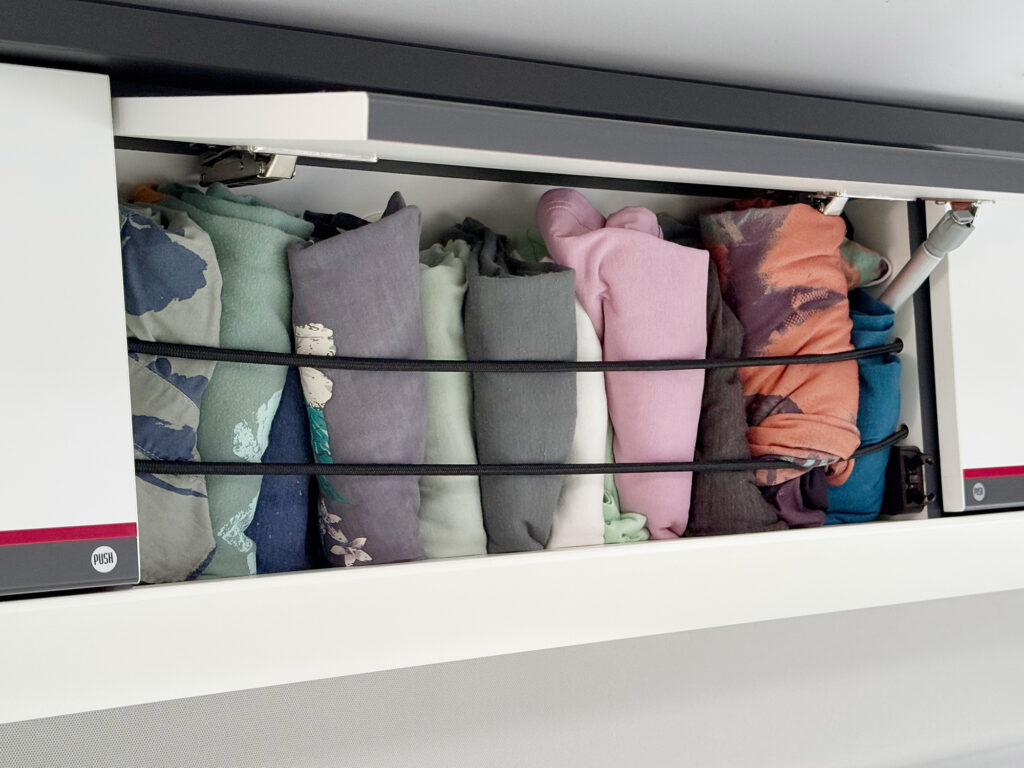
Storage space is precious in a campervan. Especially in the overhead cupboards, making good use of the available space matters. When we got our Adria SGX 640, that became clear to me pretty quickly as I started putting things away. Small bags for underwear and socks helped. Rolling T-shirts did too. But one problem remained: whenever I tried to make better use of the cupboards’ height, clothes would easily fall out towards me.
The solution was actually already in sight – further forward in our camper. Turning that idea into today’s Camperfixx bungee cord holders took several designs, some drilled-out holes and plenty of experience from everyday use. We have now been using the holders in our own camper for three years, continuously improving them based on that experience.
More room for the lifting bed – less depth in the cupboards
Our Adria SGX 640 has a rear lifting bed that can be raised between the left and right rows of cupboards, right up to the ceiling. It is a practical feature. To make it possible, however, the overhead cupboards in that area are fairly shallow. That is good for the bed, but storing clothes takes a little more thought. Making the cupboards deeper is not an option. So I wanted to organise and use the available space as effectively as possible. After all, when several people are travelling together, you need room for more than a small stack of T-shirts.
Small bags and rolled T-shirts were the starting point
My first approach was to use small bags for things like underwear and socks. They keep similar items together and stop smaller pieces from spreading throughout the compartment. I rolled T-shirts to make better use of the cupboards’ height. In principle, that worked well – as long as everything stayed in place.
That was exactly the problem: the more I packed into a cupboard, the more easily things would fall towards me when I opened it or took something out. What was missing was something to hold the contents back while getting in the way as little as possible when loading the cupboard. I wanted to make better use of the storage space, without losing some of it again to a bulky extra structure.
The idea came from our camper kitchen
Further forward in the kitchen area, cords were already stretched across a shelf to hold bottles in place. So the principle was already there. Why should it not work for clothes too? An elastic cord across the cupboard opening could hold back rolled T-shirts and small bags. When putting things away or taking them out, you could simply pull it aside. The idea was straightforward. Attaching the cord needed a little more thought.
I could have drilled holes through the internal dividers between cupboard compartments and threaded the cord through them. But I did not want to do that on the outer cupboard walls. A hole with a visible knot on the outside would not have been a neat solution for me. What I needed was a small holder that could be screwed to the inside and accommodate the cord end and its knot.
The first holder: Function before refinement
I designed the first holder and made it using 3D printing. The basic principle was already similar to today’s version: a hole at the bottom for the mounting screw, an opening at the top for the cord, and space between them for the knot. This allowed me to attach the bungee cord inside the cupboard without drilling through the visible outer wall. For the time being, my original problem was solved.
The first version was still far from perfect. Some holes were too small and had to be drilled out after printing. A screwdriver would not fit properly through the upper opening, making it unnecessarily awkward to tighten the screw. The shape also still required support structures during printing, which then had to be removed. For our own cupboard, the main thing was that it worked. But there was still plenty of room to improve its appearance, installation and production.
From a solution for our own camper to a product
When I realised that other campers liked the idea and could use it too, I thoroughly revised the holder. A part that I drill out and finish by hand after printing serves its purpose for my own use. A product for others, however, should be straightforward to install and made to the right dimensions from the start. That involved working on several details:
- The shape of the head: Rounded on the outside and designed internally so the holder can be printed without additional support structures.
- The space for the knot: Large enough to accommodate the knot without making the holder unnecessarily open.
- The mounting hole: Designed for countersunk screws up to 4 mm in diameter.
- The upper opening: Sized so the cord passes through easily and the mounting screw remains accessible with a screwdriver.
- The wall thickness: Substantial enough for the holder to withstand its intended everyday loads.
The material was another part of these decisions. The holders are printed in PETG. When choosing it, I wanted a material suitable for use in a camper, where even the interior can get considerably warmer in summer. From the outside, you mainly see a small holder. But details like these determine how well it can be printed, screwed into place and used.
Why I do not use holders on every divider
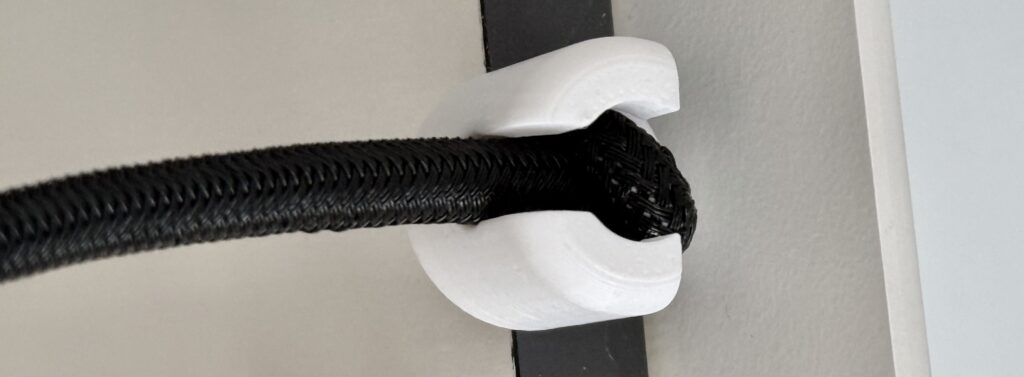
In our Adria, I installed the holders where I actually need them: at the outer ends of the row of cupboards. I threaded the 6 mm bungee cord directly through the internal dividers. This allows it to run through several cupboard compartments without having to be attached again at every divider. So you do not automatically need four holders for every individual cupboard. The number that makes sense depends on the cupboard layout, the number of cords and how you want to route them. For me, that is part of the idea too: creating a solution with just a few parts that can be adapted to the existing interior.
A sloping cupboard wall led to the next version
Straight cord routing covered most of the installation situations in our camper. One cupboard, however, ended at a sloping wall. There, I needed to mount the holder differently and guide the cord out through the side. So I developed a version with a side opening. The first design was too open, though. The cord was easy to insert, but it could also slip out too easily. The opening needed a different shape.
That development eventually led to today’s universal holder. It allows both straight and sideways cord routing, so you do not need a completely different holder for each of these installation situations. The holder designed exclusively for straight cord routing is still available. If you do not need a side opening, it offers a more enclosed shape that I particularly like the look of without an additional cover cap.
The idea for the caps came while putting clothes away
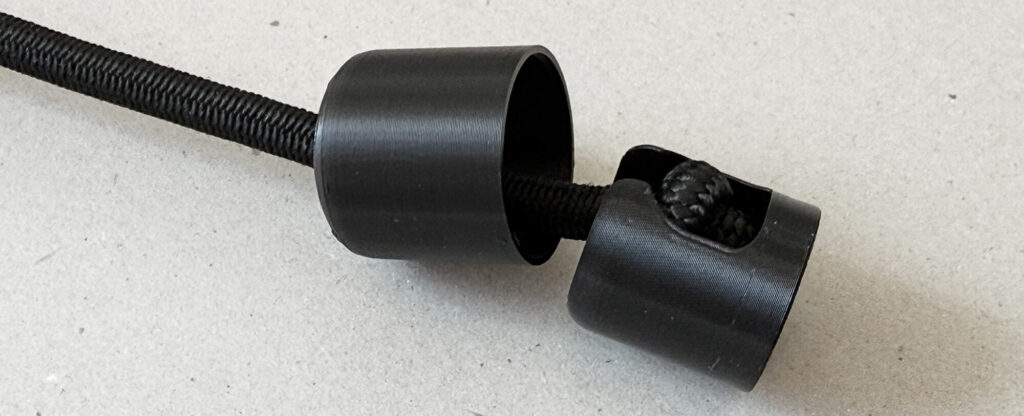
The next improvement came from using the holders again. While loading the cupboards, I stretched the bungee cord quite far a few times and moved it in a way that caused it to pop out of the open guide. After all, you are not always especially careful when putting clothes away. That led to the idea of matching cover caps. They would close off the open guide and help prevent the cord from popping out.
It was important to me to keep the existing holders. Anyone who had already installed them should not have to replace everything to add this feature. The caps therefore had to fit the existing shape and snap securely into place. Small additional ridges inside allow them to clip onto the holder and stay firmly seated. There are two matching versions for the different cord routes: the Top Cap for the straight outlet and the Side Cap for the side outlet.
Extra retention and a neat finish
With the caps fitted, the cord guide is more enclosed. This is particularly helpful when the cord is stretched further or moved sideways while loading the cupboard. There is also a second benefit: the knot is hidden beneath the cover. Inside a clothes cupboard, that is mostly a matter of personal preference. But when a holder is installed somewhere clearly visible, the enclosed finish does make a difference to its appearance. The caps therefore add two things to the original solution that proved useful through continued use: extra retention and a tidier look.
Developed in an Adria, suitable for other campers too
The starting point was the shallow cupboards in our Adria SGX 640. But the underlying problem is not limited to this model. In other campervans and motorhomes, an elastic cord can also help hold clothes and lightweight items in open cupboard compartments or behind a cupboard door. What matters is the individual installation situation and having a suitable place to attach the holders.
In our camper, small bags, rolled clothes and the stretched cords now work together. This lets me make better use of the height of the compartments without the front row falling out as soon as I open the cupboard. The holders do not make the cupboard bigger. But they help me make better use of the space already there.
Small improvements from everyday camper life
The bungee cord holders grew out of a specific problem in our own camper. At first, the aim was simply to keep clothes inside the cupboard. Then came easier installation, improved production, sideways cord routing and, finally, the caps that could be added to existing holders. Every step had a practical reason. Some things only become apparent when you use a part yourself, over and over again. These are exactly the kinds of solutions I want to develop with VANKIT: small improvements that make a difference in everyday camper life.
Camper Life. Fixed.
Would you like to organise your camper cupboards in a similar way? Here you will find the bungee cord holders for straight cord routing and the universal holders for straight and sideways cord routing – both available with optional cover caps.